
Kitab Markaz
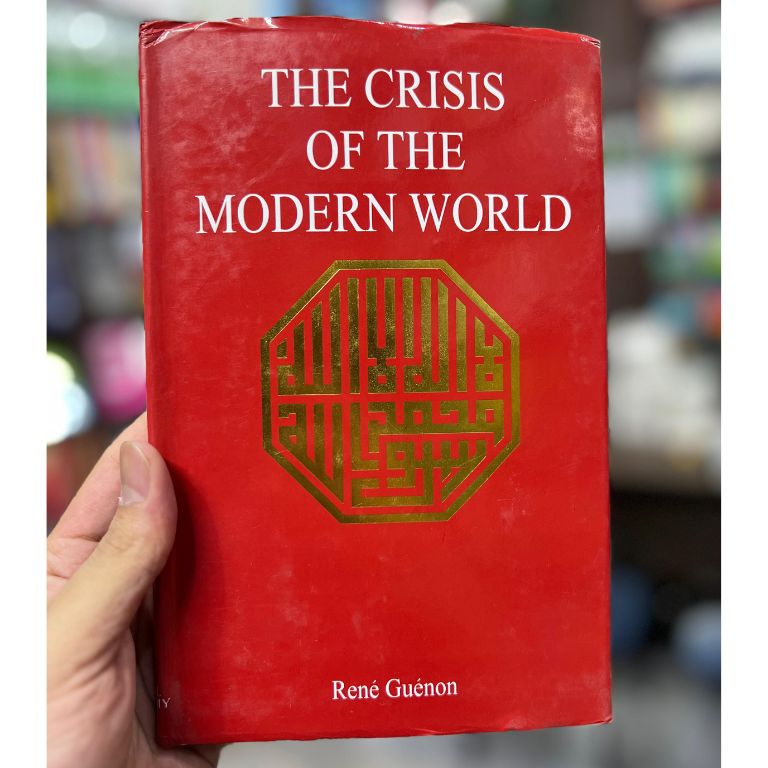
The Crisis Of The Modern World
The Crisis Of The Modern World
Couldn't load pickup availability
We live in a time of crisis. You don't need a philosopher to tell you that. You can see it in the news, feel it in the air, sense it in the emptiness that so much progress has somehow failed to fill.
But what if the crisis is not political? What if it's not economic? What if it's not even social - but metaphysical?
That is René Guénon's thesis, and he argued it with such clarity and depth that nearly a century later, no one has successfully refuted him.
The Crisis of the Modern World was published in 1927, but don't let the date fool you. This is not a historical document. It is a diagnosis of a disease that has only worsened with time. Guénon wrote it as the closest thing he ever produced to a manifesto - a call to action, though the action he envisioned was not political agitation but intellectual awakening.
The book begins where any genuine understanding must begin: with the traditional doctrine of cosmic cycles. We are living, Guénon argues, in the Kali Yuga - the Dark Age - the final phase of the present cycle of humanity. This is not poetic metaphor but precise metaphysical description. The characteristics of this age are predictable: the loss of spiritual intuition, the inversion of hierarchy, the reign of quantity over quality, the exaltation of action over knowledge.
And then Guénon shows how the modern West embodies these characteristics perfectly.
He examines:
- The Western deviation - how the West lost its connection to tradition, beginning with the Renaissance and accelerating through the Enlightenment
- The reign of individualism - the illusion that the individual human being is the center of reality
- The confusion of knowledge and information - the modern obsession with accumulating facts while losing access to wisdom
- The tyranny of action - the belief that doing matters more than being, that progress is always good, that motion is the same as direction
- The social chaos that inevitably results when traditional hierarchies collapse
But Guénon is not merely a critic. He also points toward a way forward - though it is not the way most people expect. He does not call for political revolution or social reform. Such things, he knew, only treat symptoms. He calls for something deeper: the restoration of the intellect. Not intellect in the modern sense - reason cut off from its source -but intellect as the faculty of metaphysical knowledge, the capacity to see things as they truly are.
He envisions a small number of Western intellectuals capable of returning to traditional principles, of preserving the "seeds" of Tradition through the darkness, and perhaps - under favorable circumstances - of helping to initiate a genuine renewal. It is not a program for mass movements. It is a call to those who have eyes to see and ears to hear.
For the Pakistani reader, this book is essential on multiple levels.
First, Pakistan, like all Muslim societies, stands at the intersection of tradition and modernity. We feel the pull of the West - its technology, its education, its values - even as we sense that something is wrong. Guénon gives us the language to name what is wrong, and the principles by which to judge what can be accepted and what must be refused.
Second, Guénon himself eventually embraced Islam. His critique of the modern world is not the complaint of a secular intellectual but the witness of one who found his way to the truth and spent his life pointing others toward it. When he speaks of tradition, he speaks of something he lived.
Third, this book is the necessary prelude to Guénon's magnum opus, The Reign of Quantity and the Signs of the Times, which deepens the analysis to a level few readers can reach without preparation. Read The Crisis of the Modern World first. Then go deeper.
As Guénon writes in his preface: "It is certainly no accident that so many people at the present time should be obsessed with the idea of the 'end of the world', but anyone wishing to appreciate the true character of the present period must possess at least a certain amount of data on the subject. We shall begin therefore by showing that its characteristic features correspond with the indications supplied from time immemorial by the traditional doctrines regarding the cyclic period of which it forms a part."
The Crisis of the Modern World is available now at Kitab Markaz. We deliver across Pakistan and worldwide - so this voice of clarity in an age of confusion can reach you, wherever you are.
Shipping & Returns
Shipping & Returns
Delivery all over Pakistan, Delivery time 4-5 days maximum, if you require any further questions or help your can contact us 0323-4400940
