

Kitab Markaz
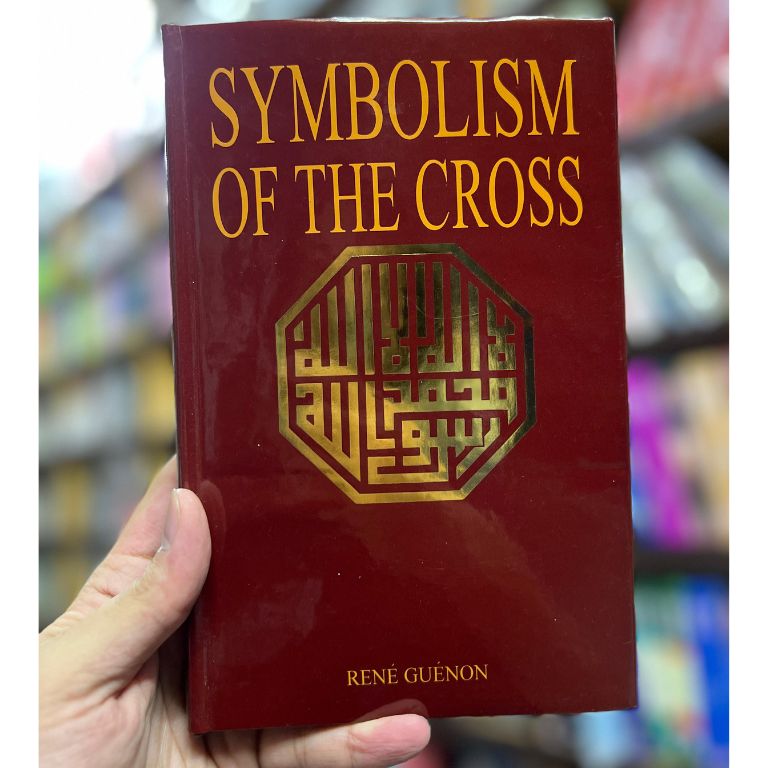
Symbolism Of The Cross
Symbolism Of The Cross
Couldn't load pickup availability
There are books that inform you. There are books that challenge you. And then there are books that, if you're ready for them, change the very ground you stand on.
Symbolism of the Cross is the third kind.
René Guénon was one of the most remarkable minds of the twentieth century - a French intellectual who immersed himself in Eastern metaphysics, converted to Islam, and spent his life recovering and explaining the universal truths that lie beneath the outer forms of all religious traditions. He didn't write for the casual reader. He wrote for seekers - people who sensed that reality is more than what our senses perceive, and who were willing to do the work required to understand.
This book takes up a symbol so familiar we think we already understand it: the cross. But Guénon shows that the cross is far more than the emblem of a particular historical event. It is, in fact, a universal symbol found in virtually every tradition - Hindu, Buddhist, Taoist, Islamic, Christian, and others - from the most ancient times. It represents the relationship between the principle and its manifestation, the union of opposites, the structure of the cosmos, and the path by which the manifested being returns to its source.
Guénon builds his argument around what he calls the "law of correspondence" - the principle that each thing in the manifested world expresses, in its own mode, the metaphysical principle from which it derives its reality. The cross, then, is not merely a shape. It is a diagram of existence itself:
- The vertical axis represents the hierarchy of states of being - from the lowest manifestation up to the supreme principle.
- The horizontal axis represents the extension of a particular state of being - the world we inhabit, with all its multiplicity.
- Their intersection is the point where the eternal meets the temporal, where the principle manifests in form.
Through this framework, Guénon unfolds a vision of reality that is breathtaking in its scope. He explains how the cross relates to the Hindu concept of Purusha, to the Taoist union of Heaven and Earth, to the Islamic understanding of the relationship between Allah and creation. He shows that the symbol is not arbitrary but necessary - a direct expression of the structure of reality.
What makes Guénon so valuable - and so challenging - is his refusal to simplify. He doesn't write for readers who want quick takeaways or spiritual entertainment. He writes for those willing to think, to meditate, to sit with ideas until they open. And for those readers, the rewards are immense. Doors open that no other key could unlock.
And for anyone who has ever sensed that there is more to existence than meets the eye - that symbols are not mere decorations but doorways - this book will be a companion for life.
René Guénon died in Cairo in 1951, having spent his final decades as a teacher and guide to seekers from around the world. His work has influenced everyone from Frithjof Schuon to Titus Burckhardt to Seyyed Hossein Nasr. But nothing replaces reading him directly.
Shipping & Returns
Shipping & Returns
Delivery all over Pakistan, Delivery time 4-5 days maximum, if you require any further questions or help your can contact us 0323-4400940